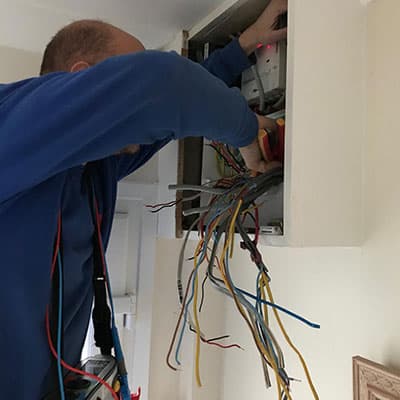
What to check on the lights, the socket and the cable before your outdoor Christmas lights go up.
Blog
Is it safe to run outdoor Christmas lights from an indoor socket?
JM Electric
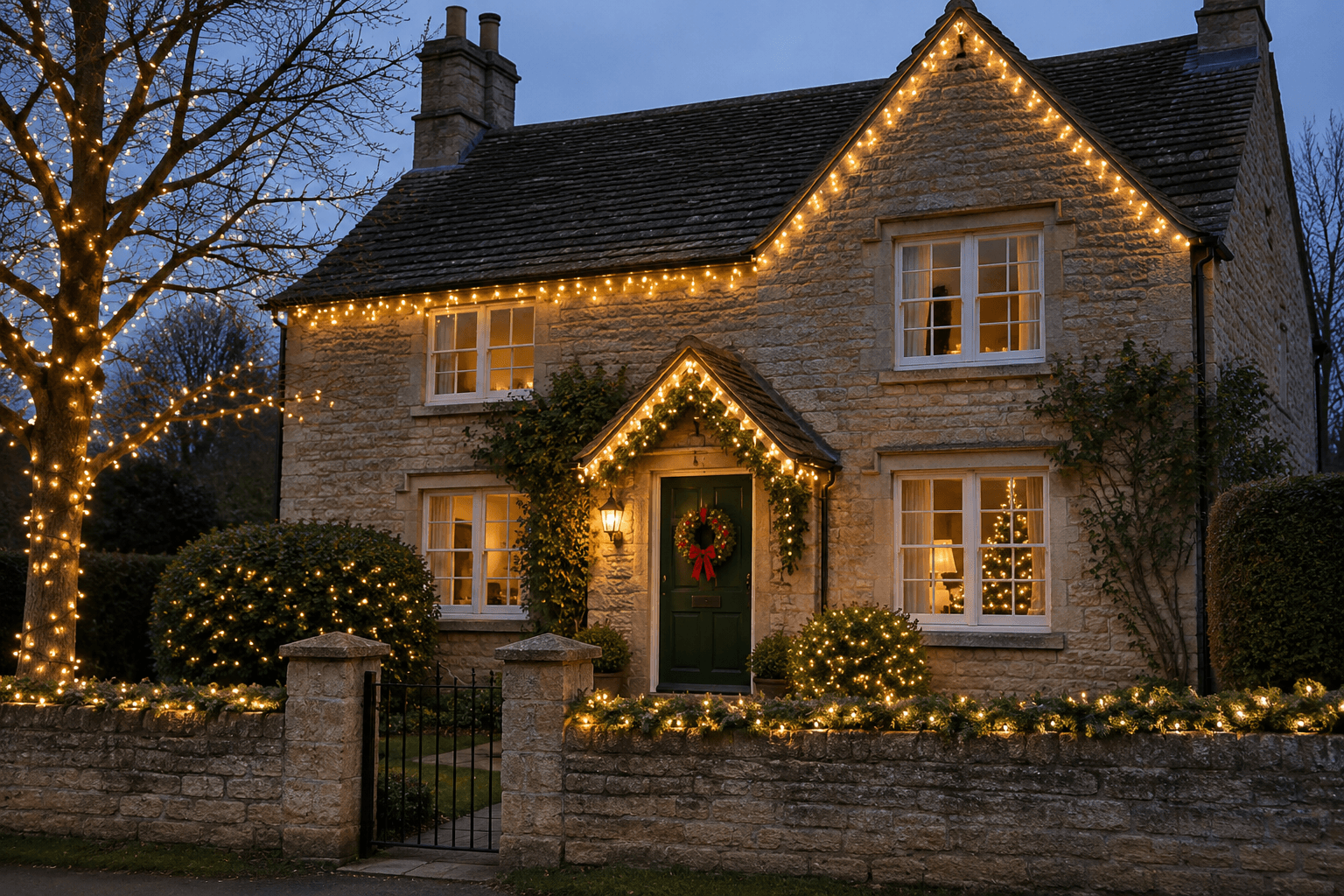
Yes, it can be safe to run outdoor Christmas lights from a socket indoors, and Electrical Safety First, the UK electrical safety charity, says the plug and any transformer should stay indoors even when the lights are made for outside. What makes it safe is everything around that socket: lights built for the weather, a socket with RCD protection, a lead that isn't crushed on its way out, and connections kept out of the wet.
This post covers choosing lights for outside, why the socket matters, getting the cable outdoors safely and the signs that something is wrong. Everything here can be checked from the outside of a plug, lead or socket. Never open up a socket, cut into a cable or join wires yourself.
Check the lights are made for outdoors
Indoor lights aren't built for rain and frost. Outdoor sets carry an IP rating (ingress protection, a code that shows how well something keeps out dust and water) or a water drop symbol on the box or the transformer.
The last number of the IP code is the one to look at for water. Electrical Safety First says it should be 3 or higher for outdoor use:
IPX3 is rain-proof
IPX4 is splash-proof, and many outdoor sets are IP44
IPX5 is jet-proof
IPX7 is watertight
If there is no rating or symbol, keep that set indoors. NICEIC also warns that some cheap, unbranded lights sold online may not meet UK safety standards.
Why low-voltage sets are the safer choice
Christmas lights run either at mains voltage, which is 230 volts, or at extra-low voltage, usually 12 to 24 volts. Low-voltage sets come with a transformer, a small box near the plug that steps the voltage down.
With a low-voltage set, the cable that goes outside carries a much smaller voltage, which greatly reduces the risk of a shock even if a bulb breaks or the cable is damaged. If you are buying new lights for outside, low-voltage LEDs are the ones to choose.
Keep the plug and transformer indoors
Even when the lights themselves are rated for outdoor use, the plug and transformer usually aren't. Plug them into a socket indoors, somewhere dry, and keep the transformer off the floor and away from any windowsill where condensation collects.
Plug the lights straight into the wall where you can. If you need an extension lead, use just one, and never plug one lead or adaptor into another.
Getting the cable outside without damaging it
A cable trapped in a window or door gets squeezed every time it closes. Over a few weeks the insulation (the plastic coating that keeps you away from the live wires) can crack or split, leaving a damaged cable out in the wet.
Choose a route where nothing closes on the cable. Low-voltage sets often have a thin cable from the transformer that is easier to route without pinching.
Don't run the lead under a door where it will be stepped on, or across a path where someone could trip.
Fix lights and cables with clips or hooks, never nails or staples, which can go through the cable.
If you have to use an extension lead outside, use one sold for outdoor use, unwind a cable reel fully, and keep every plug-in connection off the ground and out of puddles.
Why the socket needs RCD protection
An RCD (residual current device) watches for electricity leaking to earth, through water or through a person, and cuts the power in a fraction of a second. It is the single most important protection for anything used outdoors, and Electrical Safety First says all outdoor lights should be plugged into an RCD-protected socket.
To see if you have one, look at your consumer unit (the modern fuse box). An RCD, or RCBOs that do the same job circuit by circuit, will have a button marked "T" or "Test". Older boards often don't have one at all. If yours doesn't, or you aren't sure which sockets it covers, a plug-in RCD adaptor from a DIY shop gives that socket the same kind of protection until you can get the board checked.
Checks to make before you switch on
Each year, check the lights before they go up:
Look along the whole cable for cuts, kinks, bare wire or tape.
Check the plug and transformer for cracks or scorch marks.
Replace any failed bulbs with the same type, so the rest of the set doesn't overheat.
Throw away any set that is damaged. Don't try to repair it.
Once they are up, switch them off when you go to bed or go out, and check them after high winds.
Signs something is wrong
If the power trips when the outdoor lights come on, or after rain, water has probably found its way into a connection. That is the RCD doing its job, so don't keep resetting it. Unplug the outdoor lights and see if it stays on. One of our customers wrote that their "lighting breaker was constantly tripping out" because water had got "into a wiring box on an outside light". Our post on why your electricity keeps tripping explains the safe checks to try.
If you see scorch marks, smell burning or hear crackling at a plug or socket, switch it off and stop using it until it has been checked.
When an outdoor socket makes more sense
If you put lights up every year, or want power in the garden all year round, a proper outdoor socket is the safer long-term answer: no cable through a window and no lead across the path. NICEIC recommends having a registered electrician fit weatherproof, RCD-protected outdoor sockets for exactly this reason.
Fitting one is a job for a qualified electrician. Some outdoor work, such as running a new circuit, is notifiable under Part P of the Building Regulations in England, which means it must be done by a registered electrician or approved by Building Control. When we fit an outdoor socket, we check the circuit can take it, fit a weatherproof IP-rated socket with RCD protection and test it when it's finished. As NICEIC Approved Contractors, we give you the right certificate for the work.
If you'd like an outdoor socket in place before the lights go up, JM Electric can work out where it should go and fit it safely. Find out more about our garden lighting and outdoor power service and book a visit.
Want an outdoor socket before the lights go up?
If you put Christmas lights up every year, JM Electric can fit a weatherproof, RCD-protected outdoor socket and test it when it’s finished. We explain what we recommend before any work starts.
Other Articles