
How to tell whether your fuse box still protects you, what you can safely check, and when it's time for a new consumer unit.
Blog
Does my old fuse box need replacing, and how can I tell?
JM Electric
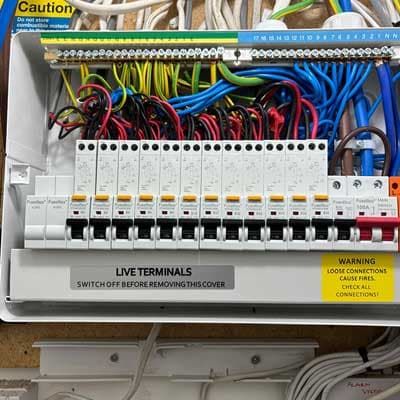
An old fuse box doesn't have to be replaced just because it is old. What matters is whether it still protects you properly. If yours has fuses you rewire by hand, no RCD protection, signs of heat damage, or no room for the circuits your home now needs, it is time to upgrade. If it is a newer board in good condition, it may have plenty of life left.
This post explains what a modern consumer unit does that an old fuse box doesn't, the signs that yours needs replacing, and what you can safely check yourself. Looking at the front of the board is fine, but never take the cover off. There are live parts behind it even when the main switch is off.
Fuse box or consumer unit, what's the difference?
"Fuse box" and "consumer unit" are often used for the same thing: the box where your electricity supply is split into circuits for lights, sockets, the cooker and so on. The difference is in what sits inside.
Older fuse boxes use fuses, small pieces of wire that melt when too much current flows. Modern consumer units use switches instead:
MCBs (miniature circuit breakers) switch a circuit off when it is overloaded or shorts out. You reset them with a flick rather than rewiring a fuse.
RCDs (residual current devices) cut the power in a fraction of a second if current leaks to earth, which is what happens when electricity passes through water or a person. This is the protection that can stop an electric shock from killing someone.
RCBOs do both jobs in one switch for each circuit, so a fault only takes out the circuit it's on.
A fuse protects the wiring from overheating. It does nothing to protect a person from a shock. That is the main reason an old fuse box falls short.
Signs your fuse box needs replacing
Any one of these is a good reason to have your board looked at:
Rewireable fuses. If you replace a blown fuse by threading new wire into a ceramic or plastic holder, the board is likely to be decades old and won't have RCD protection.
No RCD at all. Look for a switch with a "T" or "Test" button. If there isn't one, no circuit in your home has shock protection.
A wooden back, a cast iron box or a mix of separate boxes. These usually date from well before modern standards.
Scorch marks, a burning smell, buzzing or a board that feels warm. These point to loose or overheating connections. Treat them as urgent.
Frequent tripping or blowing fuses with no obvious cause. Our post on why your electricity keeps tripping explains the safe checks to try first.
No spare ways for new circuits. An extension, an electric shower, an EV charger or a new kitchen can all need circuits the old board can't take.
What a condition report tells you
The surest way to know is an Electrical Installation Condition Report, or EICR. This is a full inspection and test of your wiring and board by a qualified electrician. Homeowners are advised to have one at least every 10 years, and landlords in England must have one at least every five.
The report codes anything it finds:
C1 means danger is present and needs making safe straight away.
C2 means potentially dangerous and needs putting right urgently.
C3 means improvement recommended. It isn't dangerous, but an upgrade would make the installation safer.
A board without RCD protection will often be coded C2 or C3, depending on what the circuits supply. If your report recommends a new consumer unit, the code tells you how soon.
Does a plastic consumer unit need replacing?
Since 1 January 2016, new consumer units in homes have had to be made of non-combustible material, usually steel, so that a fire starting inside the board is more likely to stay inside it.
It doesn't mean every plastic unit has to come out. The rule applies to new installations. A plastic board fitted before 2016 that tests well and has RCD protection can be perfectly safe to keep. If it ever needs replacing, the new one will be metal.
Safe checks you can make at home
You can learn a lot from the front of the board without touching any wiring:
Look at what's inside the clear cover. Note whether you have fuses or switches, and whether any switch has a test button.
Test your RCD. Press the "T" or "Test" button. The RCD should trip straight away. Push it back up to reset. This is worth doing every six months.
Check for warning signs. Look for discolouration or scorch marks, and listen for buzzing.
Find any old paperwork. A label or certificate near the board may show when it was fitted or last tested.
Don't unscrew the cover, pull out a fuse carrier on a live board, or try to fit a new board yourself. Replacing a consumer unit is notifiable work under Part P of the Building Regulations in England, which means it must be done by a registered electrician or approved by Building Control.
What happens when we replace a board
We start with a survey, looking at the board, the wiring and the earthing, because a new board is only as good as the circuits connected to it. Testing sometimes turns up a fault in the wiring that has to be put right first, and we explain anything like that before work starts.
On the day, the power is off while we work. We remove the old board, fit the new one, connect and label each circuit, then test everything. As NICEIC Approved Contractors, we give you an Electrical Installation Certificate when the job is done.
One customer whose fuse box was "more than 30 years old" said the new one "looked better than the original" and that the place was "cleaned up very tidily afterwards". Another had an intermittent tripping fault traced and, at our suggestion, had their board changed because it was "really jammed full and was 22 years old".
If testing shows the wiring itself has reached the end of its life, our page on house rewiring explains what that involves.
If you're not sure whether your fuse box is still doing its job, JM Electric can inspect it, test your circuits and tell you plainly whether it needs replacing. Find out more about our fuseboard installation service and book a survey.
Not sure your fuse box is still up to the job?
JM Electric can inspect your board, test your circuits and tell you plainly whether it needs replacing. We explain what we find before any work starts.
Other Articles


